
Dental Implants vs Other Tooth Replacement Options: Which Is Right for You?
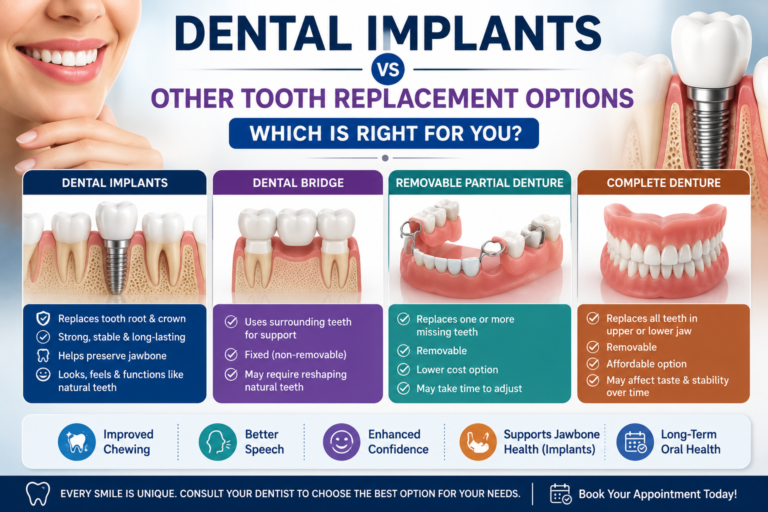
Losing a tooth can affect much more than your smile. Missing teeth can make chewing difficult, affect speech, change the way your remaining teeth meet, and may also affect your confidence. Fortunately, modern dentistry offers several tooth replacement options, including dental implants, dental bridges, and dentures.
But which option is right for you?
The answer depends on factors such as the number of missing teeth, the condition of your gums and jawbone, your overall oral health, your budget, and your long-term expectations. A professional dental evaluation is the best way to determine which treatment is suitable for your specific needs.
For patients looking for professional dental treatment in Ludhiana, Kapoor Dental Care Center provides comprehensive dental care and can help patients understand their tooth replacement options.
Learn more about dental treatments at Kapoor Dental Care Center.
What Are Dental Implants?
A dental implant is a tooth replacement option designed to replace the missing tooth root as well as the visible tooth.
A typical implant treatment involves placing a small implant fixture into the jawbone. After the implant has integrated with the surrounding bone, it can support an artificial tooth, commonly called a crown.
A dental implant generally has three main components:
- Implant: The portion placed into the jawbone.
- Abutment: The connector between the implant and replacement tooth.
- Crown: The visible tooth-shaped restoration.
Because implants are anchored into the jawbone, they can provide a stable foundation for replacing missing teeth.
What Are the Main Alternatives to Dental Implants?
Dental implants are not the only way to replace missing teeth. Depending on your situation, your dentist may discuss:
- Dental bridges
- Removable partial dentures
- Complete dentures
- Implant-supported dentures
Each option has advantages and limitations.
Dental Implants vs Dental Bridges
A dental bridge uses one or more artificial teeth supported by neighboring teeth or other structures.
Advantages of Dental Bridges
A bridge can:
- Replace one or more missing teeth
- Restore chewing ability
- Improve the appearance of your smile
- Usually be completed without implant surgery
- Provide a fixed replacement rather than a removable appliance
However, conventional bridges may require preparation of neighboring teeth to support the restoration.
When Might a Bridge Be Considered?
A bridge may be an option when:
- You have healthy supporting teeth.
- You want a fixed tooth replacement.
- An implant is not suitable for your current dental condition.
- You prefer to avoid implant surgery.
Your dentist can evaluate the supporting teeth and surrounding tissues before recommending a bridge.
Dental Implants vs Dentures
Dentures are removable dental appliances used to replace multiple missing teeth or, in the case of complete dentures, an entire arch of teeth.
Advantages of Dentures
Dentures can:
- Replace several missing teeth
- Replace an entire arch
- Provide a non-surgical tooth replacement option
- Often be more accessible for patients who are not candidates for implants
- Be removed for cleaning
However, removable dentures may require an adjustment period and can move during chewing or speaking depending on their fit and the condition of the supporting tissues.
What Are Implant-Supported Dentures?
Implant-supported dentures combine aspects of traditional dentures and dental implants.
Instead of relying entirely on the gums and underlying tissues for support, the denture is stabilized by dental implants.
This can provide greater stability compared with conventional removable dentures in appropriate patients.
The number and placement of implants depend on the patient’s individual anatomy and treatment plan.
Dental Implants vs Other Options: Quick Comparison
Feature | Dental Implants | Dental Bridges | Dentures |
Fixed replacement | Yes | Yes | Usually removable |
Replaces tooth root | Yes | No | No |
Can replace one tooth | Yes | Yes | Yes |
Can replace multiple teeth | Yes | Yes | Yes |
Can replace a full arch | Yes, with appropriate treatment | Not usually the primary option | Yes |
Requires surgery | Usually | No | No |
Removable by patient | No | No | Usually yes |
Requires supporting teeth | No for the implant itself | Usually yes | No |
Jawbone preservation benefit | Implant placement can help maintain bone in the treated area | No | No |
The right choice depends on your individual dental condition rather than simply choosing the option with the most features.
Are Dental Implants Better Than Dentures?
Dental implants are not automatically better for every patient.
For suitable candidates, implants can provide a stable, fixed tooth replacement and can also help preserve the jawbone around the implant site. However, implant treatment may require surgery, sufficient bone support or additional procedures, and a longer treatment process.
Dentures can be a practical option for patients who need to replace several teeth or an entire arch, particularly when implants are not appropriate or when a removable solution is preferred.
The best choice should be based on your oral health, anatomy, treatment goals, and dentist’s recommendation.
Are Dental Implants Better Than Bridges?
Dental implants can replace a missing tooth without relying on neighboring teeth for support.
A conventional bridge, on the other hand, generally uses adjacent teeth to support the replacement tooth.
However, implants require surgical placement and sufficient bone and tissue conditions. A bridge may be a simpler alternative for some patients.
Your dentist can compare both options after examining the missing tooth area and the neighboring teeth.
Who Is a Good Candidate for Dental Implants?
Dental implant suitability depends on several factors.
A patient may be considered for implants when they have:
- One or more missing teeth
- Healthy gums or treatable gum disease
- Adequate jawbone to support an implant
- Good oral hygiene
- A commitment to maintaining regular dental care
- No uncontrolled oral health problems that would interfere with treatment
Bone loss does not necessarily mean implants are impossible. In some situations, procedures such as bone grafting may be considered to improve the foundation for implant placement.
A comprehensive dental examination and appropriate imaging are necessary before treatment planning.
Can Dental Implants Replace a Single Missing Tooth?
Yes. A single dental implant can be used to replace one missing tooth in appropriate patients.
A common single-tooth implant restoration consists of an implant, an abutment, and a crown.
One important advantage is that the implant-supported crown does not generally require the neighboring teeth to be prepared in the same way as a conventional tooth-supported bridge.
Can Dental Implants Replace Multiple Missing Teeth?
Yes. Multiple implants can be used to replace several missing teeth.
Depending on the number and location of missing teeth, treatment may involve:
- Individual implant-supported crowns
- An implant-supported bridge
- Multiple implants supporting a larger restoration
- Implant-supported dentures
The most suitable approach depends on your jawbone, gum health, bite, number of missing teeth, and overall treatment goals.
What Happens If You Leave a Missing Tooth Untreated?
A missing tooth should not automatically be ignored simply because it does not cause immediate pain.
Over time, missing teeth can contribute to changes in chewing function and tooth position. The surrounding teeth may shift into the empty space, potentially affecting the bite.
Bone loss can also occur in the area where a tooth has been lost because the natural tooth root is no longer stimulating the surrounding bone.
This is one reason dentists often recommend discussing tooth replacement options after tooth loss.
Are Dental Implants Painful?
Dental implant placement is performed using local anesthesia, so patients generally should not feel the surgical procedure itself.
Some discomfort, swelling, or tenderness may occur after treatment as the tissues heal. Your dentist will provide appropriate aftercare instructions and guidance for managing the recovery period.
Every patient’s experience can be different.
How Long Does Dental Implant Treatment Take?
Dental implant treatment does not always happen in a single appointment.
The timeline can vary depending on:
- Whether a tooth needs to be extracted
- Bone availability
- Whether bone grafting is required
- Gum health
- Implant integration
- Type of final restoration
- Individual healing response
Some patients may require several months from initial implant placement to final restoration.
Your dentist can provide a more accurate timeline after evaluating your teeth and jawbone.
How Long Do Dental Implants Last?
Dental implants are designed as a long-term tooth replacement option, but their success depends on proper care and several biological and mechanical factors.
Good oral hygiene, regular dental checkups, healthy gums, and avoiding damaging habits can help protect the implant and surrounding tissues.
The crown or other restoration attached to the implant may eventually need maintenance or replacement even when the implant itself remains stable.
How Do You Take Care of Dental Implants?
Caring for dental implants is similar in many ways to caring for natural teeth.
Important habits include:
- Brush your teeth regularly.
- Clean between your teeth and around the implant.
- Follow your dentist’s instructions.
- Attend regular dental checkups.
- Maintain good gum health.
- Avoid smoking or tobacco use.
- Report unusual pain, swelling, or mobility to your dentist.
Implants are not completely maintenance-free. Good long-term oral hygiene is essential.
What About Dental Implants for Older Adults?
Age alone does not necessarily prevent someone from receiving dental implants.
The more important considerations include overall health, bone condition, gum health, oral hygiene, and the patient’s ability to undergo and maintain treatment.
Older adults with missing teeth may benefit from discussing implants, bridges, dentures, or implant-supported dentures with their dentist.
Why Choose Kapoor Dental Care Center in Ludhiana?
If you are searching for a dental implant clinic in Ludhiana, choosing a dental center that can evaluate your complete oral health is important.
Kapoor Dental Care Center provides comprehensive dental services, including dental implants and other treatments designed to address different oral health needs.
The dental team can evaluate your missing teeth, gums, supporting bone, bite, and overall oral health before discussing appropriate treatment options.
Whether you need to replace a single missing tooth, multiple teeth, or are considering a full-mouth tooth replacement solution, a personalized consultation can help you understand the available choices.
You can learn more about Kapoor Dental Care Center and its dental services at https://kapoordentalludhiana.in/.
Frequently Asked Questions About Dental Implants and Tooth Replacement
1. What is the best replacement for a missing tooth?
There is no single best option for everyone. Dental implants, bridges, and dentures can all be appropriate depending on the patient’s oral health, bone condition, number of missing teeth, budget, and treatment preferences.
2. Are dental implants better than dentures?
For suitable patients, dental implants can provide a fixed and stable tooth replacement and can help maintain bone around the implant. Dentures may be more appropriate for some patients because they are removable and can replace multiple or all teeth.
3. Are dental implants better than bridges?
Implants can replace a missing tooth without relying on neighboring teeth for support. However, bridges may be suitable for patients who prefer a non-surgical fixed option or are not candidates for implants.
4. How much do dental implants cost in Ludhiana?
The cost depends on the number of implants, type of implant and restoration, diagnostic requirements, bone condition, and whether additional procedures are required. A dental consultation is necessary for an accurate treatment estimate.
5. Can one dental implant replace one tooth?
Yes. A single implant can support a crown designed to replace one missing tooth when the patient is an appropriate candidate.
6. Can dental implants replace multiple teeth?
Yes. Multiple implants can support individual crowns, bridges, or other restorations depending on the patient’s needs.
7. What happens if I don’t replace a missing tooth?
Leaving a missing tooth untreated can affect chewing, tooth position, bite, and the surrounding bone over time. Your dentist can explain whether replacement is recommended in your specific situation.
8. How long does it take to recover from dental implant surgery?
Healing time varies from person to person. The overall treatment timeline also depends on implant integration and whether procedures such as bone grafting are required.
9. Are dental implants permanent?
Dental implants are intended as a long-term tooth replacement solution, but they require proper oral hygiene and professional maintenance. The visible restoration may need maintenance or replacement over time.
10. Where can I get dental implants in Ludhiana?
If you are considering dental implants, you can consult Kapoor Dental Care Center in Ludhiana for an evaluation and personalized treatment discussion.
Visit Kapoor Dental Care Center to learn more about available dental services.
Final Thoughts
Choosing between dental implants, bridges, and dentures is an important decision that should be based on your individual oral health rather than simply choosing the most popular treatment.
Dental implants can offer a stable, long-term solution for suitable patients, while bridges and dentures remain valuable options for many people with missing teeth.
The best approach is to have your teeth, gums, jawbone, and bite professionally evaluated. Your dentist can then explain the benefits, limitations, treatment timeline, and expected maintenance of each option.
If you are looking for dental implants in Ludhiana or want to understand which tooth replacement option is right for you, consider scheduling a consultation with Kapoor Dental Care Center.
Visit Kapoor Dental Care Center to explore dental implant and other dental care services.