
Single Tooth Implant vs Dental Bridge: What Is the Difference?
Losing a tooth can affect more than just your smile. A missing tooth may make chewing difficult, affect the way you speak, and allow nearby teeth to shift into the space. Fortunately, modern dentistry offers several options for replacing a missing tooth, with single tooth implants and dental bridges being two commonly considered solutions.
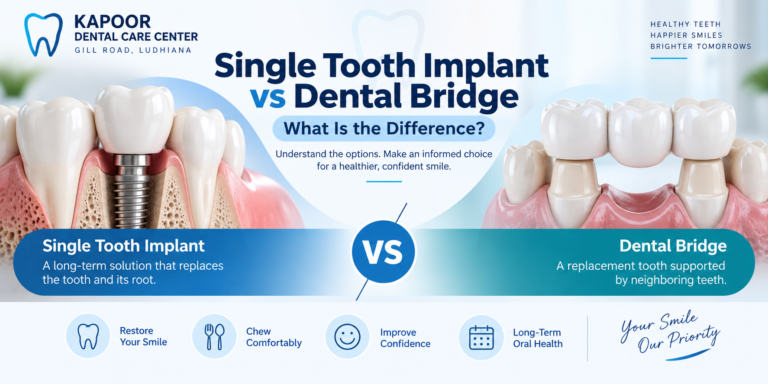
Although both treatments can replace a missing tooth and restore your smile, they work in different ways. A dental implant replaces the missing tooth and its root, while a dental bridge uses neighboring teeth to support a replacement tooth.
Understanding the differences between a single tooth implant and a dental bridge can help you have a more informed conversation with your dentist about which option may be appropriate for your oral health.
If you are considering tooth replacement in Ludhiana, Kapoor Dental Care Center, Gill Road, Ludhiana, can evaluate your teeth, gums, bone condition, and overall oral health before discussing suitable treatment options.
What Is a Single Tooth Implant?
A single tooth implant is a tooth replacement option designed to replace a missing tooth without relying on the neighboring teeth for support.
A dental implant generally consists of three main components:
- Implant: A small titanium or other suitable biocompatible post placed into the jawbone.
- Abutment: A connector attached to the implant.
- Dental crown: The visible tooth-shaped restoration placed over the abutment.
Once the implant has integrated with the surrounding bone and the appropriate healing period has passed, the final crown can be placed.
The result is a replacement tooth designed to look and function similarly to a natural tooth.
What Is a Dental Bridge?
A dental bridge is another way to replace a missing tooth.
A traditional dental bridge generally consists of an artificial replacement tooth, known as a pontic, supported by crowns attached to adjacent teeth.
For example, if one tooth is missing between two healthy teeth, the neighboring teeth may be prepared to support the bridge.
Unlike an implant, a traditional dental bridge does not require placement of an implant post into the jawbone.
Single Tooth Implant vs Dental Bridge: Key Differences
While both options can replace a missing tooth, there are several important differences.
1. How They Are Supported
The biggest difference is how the replacement tooth is supported.
A single dental implant is anchored into the jawbone and acts as the foundation for the replacement tooth.
A dental bridge is supported by the neighboring teeth.
This means an implant does not normally require the adjacent healthy teeth to be prepared as bridge supports.
2. Effect on Neighboring Teeth
With a traditional dental bridge, the neighboring teeth may need to be reshaped so that crowns can be placed over them.
With a single tooth implant, the adjacent teeth generally do not need to be prepared to support the replacement tooth.
This can be an important consideration when the neighboring teeth are healthy and do not otherwise require crowns.
3. Treatment Process
The treatment process is different for each option.
Single Tooth Implant Process
A typical implant treatment may involve:
- Dental examination and imaging
- Assessment of the jawbone and gums
- Implant placement
- Healing and integration with the jawbone
- Placement of an abutment
- Placement of the final dental crown
The exact sequence and treatment time depend on the patient’s individual condition.
Dental Bridge Process
A traditional bridge treatment generally involves:
- Examination of the missing tooth area
- Evaluation of the neighboring teeth
- Preparation of the supporting teeth
- Taking dental impressions or digital scans
- Fabrication of the bridge
- Placement and adjustment of the final bridge
The dentist will determine the appropriate approach based on the condition of the teeth and gums.
4. Treatment Time
Treatment time is another difference between implants and bridges.
A dental bridge can often be completed relatively quickly once the supporting teeth have been prepared and the restoration has been fabricated.
A dental implant usually involves a longer treatment process because the implant needs time to integrate with the jawbone before the final restoration is placed.
However, treatment timelines vary significantly between patients.
Factors such as bone condition, gum health, the need for additional procedures, and the location of the missing tooth can affect the overall timeline.
5. Jawbone Preservation
When a tooth is lost, the area of the jawbone that previously supported the tooth can gradually change because it no longer receives the same stimulation from the tooth root.
A dental implant is placed into the jawbone and can help maintain stimulation in the area.
A traditional dental bridge replaces the visible tooth but does not replace the missing tooth root.
For this reason, bone preservation can be an important factor when discussing implant treatment with a dentist.
6. Appearance
Both implants and bridges can be designed to provide a natural-looking appearance.
A dental crown attached to an implant can be customized to match the surrounding teeth in terms of shape, size, and color.
A dental bridge can also be made to blend with the natural teeth.
The final appearance depends on factors such as the quality of the restoration, tooth position, gum health, and the dentist and dental laboratory involved in the treatment.
7. Comfort and Function
Both options can restore chewing function after a missing tooth.
An implant-supported crown is fixed into the jaw and does not rely on neighboring teeth for support.
A dental bridge is also fixed in place rather than being removable in the case of a traditional bridge.
Your dentist can evaluate your bite, the position of the missing tooth, and the condition of the surrounding teeth before recommending an appropriate option.
8. Cleaning and Oral Hygiene
Oral hygiene is important with both treatment options.
A single implant-supported crown should be brushed and cleaned regularly, just like your natural teeth. Additional cleaning around the implant may also be recommended by your dental professional.
A dental bridge requires careful cleaning around and underneath the bridge because food particles and plaque can accumulate around the restoration and supporting teeth.
Your dentist or dental hygienist can demonstrate the appropriate brushing, flossing, and interdental cleaning techniques.
9. Durability and Long-Term Care
Both dental implants and bridges can provide long-term tooth replacement when properly planned, maintained, and cared for.
However, their longevity depends on several factors, including:
- Oral hygiene
- Gum health
- Bite forces
- Smoking and tobacco use
- Regular dental checkups
- The condition of surrounding teeth
- Quality and maintenance of the restoration
An implant does not mean that the surrounding teeth and gums no longer require dental care. Regular checkups remain important.
10. Cost Considerations
The cost of replacing a missing tooth varies depending on the treatment selected and the individual case.
A dental implant may involve several stages, including implant placement, abutment placement, and the final crown.
A dental bridge may have a different initial cost because it does not require implant placement.
However, treatment decisions should not be based on price alone. The condition of your teeth, gums, bone, oral hygiene, and long-term treatment requirements should also be considered.
A dentist can provide a personalized estimate after examining your mouth.
Who May Be a Candidate for a Single Tooth Implant?
A single tooth implant may be considered for patients who have:
- One missing tooth
- Healthy or adequately treated gums
- Adequate bone to support an implant, or who may be suitable for bone augmentation
- Good overall oral hygiene
- A commitment to maintaining regular dental care
Not every patient is automatically a candidate for an implant. A detailed dental examination and appropriate imaging are necessary before treatment.
Who May Benefit From a Dental Bridge?
A dental bridge may be considered when:
- One or more teeth are missing
- Neighboring teeth can adequately support the bridge
- The patient prefers a non-implant tooth replacement option
- The supporting teeth are suitable for bridge treatment
The suitability of a bridge depends heavily on the health and strength of the supporting teeth.
Which Is Better: Implant or Dental Bridge?
There is no single option that is appropriate for every patient.
The choice between a single tooth implant and a dental bridge depends on several individual factors, including:
- Health of the neighboring teeth
- Condition of the gums
- Jawbone density and volume
- Location of the missing tooth
- Bite and chewing forces
- Overall oral health
- Treatment preferences
- Budget and treatment timeline
For example, if the neighboring teeth are healthy and do not require crowns, an implant may be discussed as an option that does not depend on those teeth for support.
On the other hand, if the neighboring teeth already require crowns or are otherwise suitable for supporting a bridge, a dental bridge may be considered.
Your dentist can explain the advantages, limitations, risks, and expected maintenance requirements of each option for your specific situation.
What Should You Ask Your Dentist Before Choosing?
Before deciding between an implant and bridge, consider asking your dentist:
- Is my jawbone suitable for an implant?
- Are my neighboring teeth healthy enough to support a bridge?
- Do I need any additional dental treatment first?
- How long will the treatment take?
- What type of restoration will I need?
- What will the maintenance requirements be?
- What are the expected costs?
- Which option is appropriate for my particular tooth and oral health?
These questions can help you understand your treatment choices before proceeding.
Tooth Replacement at Kapoor Dental Care Center, Gill Road, Ludhiana
If you have a missing tooth and are searching for a dentist for dental implants in Ludhiana, Kapoor Dental Care Center, Gill Road, Ludhiana, can help you understand the available tooth replacement options.
At Kapoor Dental Care Center, a dental evaluation can help determine the condition of the missing tooth area, neighboring teeth, gums, and supporting bone. Based on the examination, your dentist can discuss whether a dental implant, dental bridge, or another treatment option may be suitable.
Patients looking for dental implants in Ludhiana can visit the Kapoor Dental Care Center website to learn more about the clinic and its dental care services.
If you are unsure whether an implant or bridge is right for you, scheduling a consultation is a useful first step. A personalized examination is necessary because tooth replacement options can vary considerably from one patient to another.
How to Care for Your Replacement Tooth
Regardless of whether you choose an implant or bridge, maintaining good oral hygiene is essential.
Follow these basic habits:
- Brush twice a day with fluoride toothpaste.
- Clean between your teeth regularly.
- Pay special attention to the gumline.
- Avoid using your teeth to open packages or bite hard objects.
- Attend regular dental checkups.
- Follow your dentist’s recommendations for professional cleaning.
- Report persistent discomfort, swelling, or changes around the restoration.
Good oral hygiene can help protect the replacement tooth as well as your remaining natural teeth.
Final Thoughts
A missing tooth does not have to mean living with difficulty chewing or feeling uncomfortable about your smile. Single tooth implants and dental bridges are two established options for replacing missing teeth, but they work differently and have different treatment requirements.
An implant replaces the missing tooth while also providing a root-like foundation in the jawbone. A traditional dental bridge replaces the visible tooth using neighboring teeth as support.
The most appropriate option depends on your oral health, bone condition, neighboring teeth, treatment preferences, and long-term dental needs.
If you have a missing tooth and want to understand your options, consult a qualified dental professional for an individual assessment.
For patients in Ludhiana, Kapoor Dental Care Center, Gill Road provides dental consultations and treatment options for different oral health needs. You can visit the dental care center in Ludhiana to learn more and schedule a consultation.